Grid, Body, and City (2025 - Ongoing)
Research-led series in film and spatial practice
Grid, Body, and City is an ongoing interdisciplinary project series exploring how bodily experience is shaped by the spatial and social structures of cities — and how the body, in turn, reinterprets and transforms urban space. Each chapter situates itself within a specific cities and unfolds through research archives, essay film, embodied mapping, and site-specific intervention, forming a long-term investigation into how cities choreograph bodies across time and geography.
-
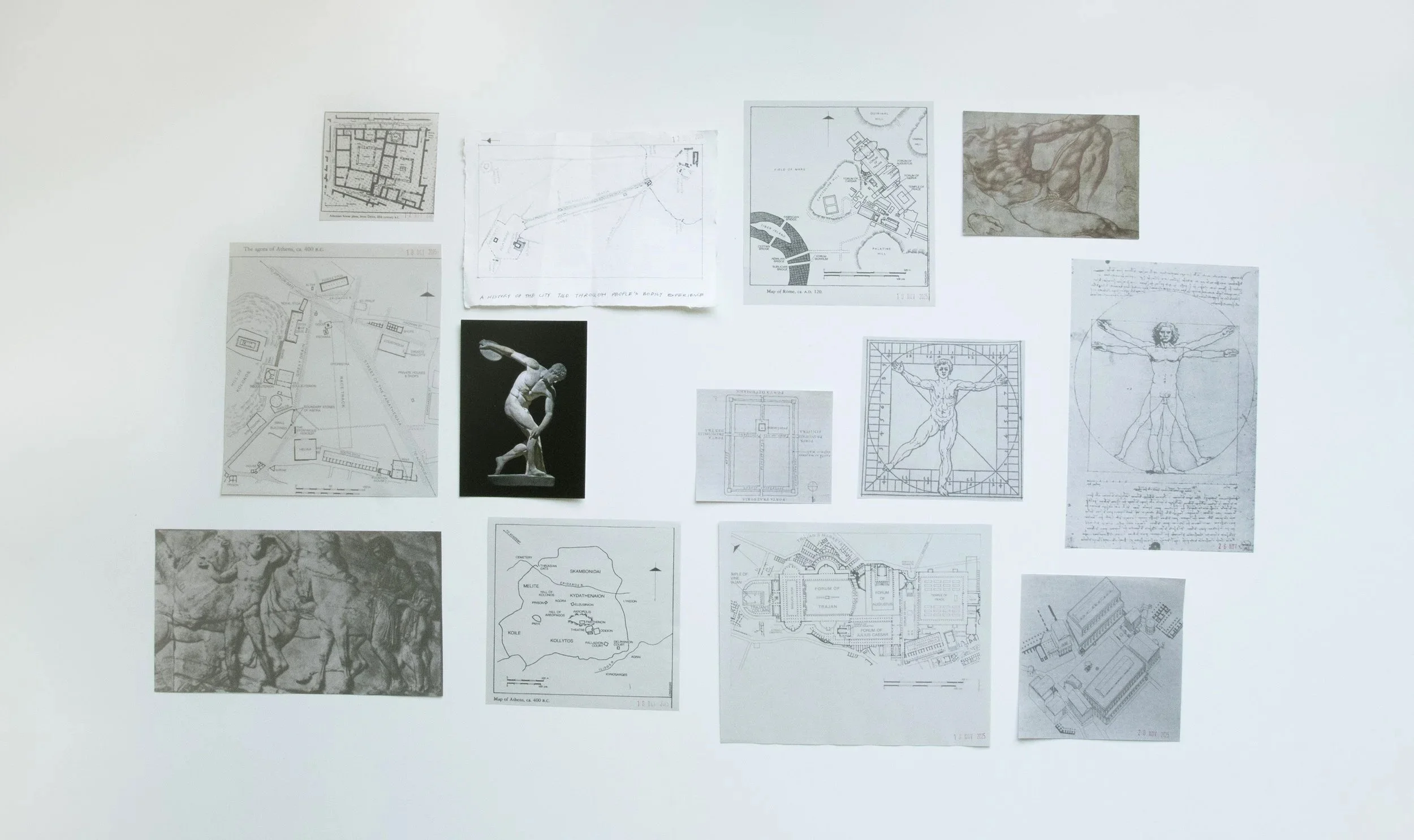
Research archives studying the ancient urban forms of Athens as a city of the public body, and Rome as a city of the disciplined body (Sennett, 1994)Chapter I : London
Replace the Cup (ongoing)
Replace the Cup investigates London’s remaining drinking fountains as monuments of the “civilised city.” At Holborn (1859), the first public drinking fountain in Britain was built to meet the body without permission - mouth to stone, thirst to infrastructure, water offered without purchase as a democratic gesture of care. But public care was never innocent. Victorian fountains were often placed opposite pubs as part of the temperance movement, inscribed with biblical phrases promoting sobriety and the names of wealthy donors carved into stone - turning public infrastructure into moral instruction and prestige.
These fountains trained the citizen, disciplining bodies through sobriety and quiet forms of social control. Today, the cup is gone, the chain is missing, and other fountains stand fenced off or sealed. What remains is an empty monument. Yet the fountain returns in modern form in response to the plastic crisis - now stamped with corporate logos, replacing civic care with branded visibility.
-
The city first learned through the pain of bodies.
Water moved through London like a hidden threat.
The Thames carried the leaking waste of a growing empire.
Bodies drank from the same river that consumed them.
The city discover that disease travelled not through air,
But through infrastructure.
G A I N I N G
Water became political.
The victorian city responded by rebuilding the body through sanitation.
Sewers were buried beneath the street.
Pipes entered the walls.
The fountain emerged above ground like a civic monument to purity.
“Replace the cup”
The first public drinking fountain was built at Holborn
A new choreography of the urban body.
To wait.
To stop.
To bend.
To drink.
To Share.
Free water might presented as kindness,
Architecture was introduced as care.
Is the kindness in the city innocent?
“ THIS IS THE ONLY SOCIETY FOR PROVIDING FREE SUPPLIES OF WATER FOR MAN AND BEAST IN THE STREETS OF LONDON ”
324 Fountains were built,
nearly 300,000 people drink daily in the summer;
8,000 of people at one Fountain in a single day,
young and old,
working men,
who would otherwise be compelled to resort to the public house to quench their thirst.
The Association thus not only relieves one of the most pressing wants of the itinerant poor,
but also prevents many of the industrial classes from contracting habits of intemperance.
C H A I N I N G
Architecture is never neutral.
The fountain intentionally stood opposite the pub.
Sobriety against intoxication.
Discipline against excess.
The temperance movement imagined water as moral architecture,
A clear body for a cleaner city.
"Jesus said whosoever drinketh of this water shall thirst again but whosoever drinketh of the water I shall give him shall never thirst"
Bibical inscriptions were carved into stone.
Donors engraved their name beside the act of giving.
A gift from the successful to the thirsty.
“ I WAS THIRSTY AND YE GAVE ME DRINK ”
Infrastructure became inseparable from virtue, religion, and prestige.
“ A THANK OFFERING TO THE GOD OF ALL MERCIES
BE KIND AND MERCIFUL TO ALL ANIMALS ”
Even kindness required instruction.
The shared cup was attached by chain.
One mouth after another.
One body after another.
The chain did not only hold the cup.
It held the body close to morality.
Bodies gathered around fountains under instruction:
Drink correctly,
Wait correctly,
Behave correctly,
Replace correctly.
D R A I N I N G
First the city taught us to share.
Then it taught us not to touch.
“ GOD BLESS THE POOR!
TEACH THEM TRUE LIBERTY
MAKE THEM-FROM-STRONG DRINK FREE ”
Now the fountain stand silent.
Some sealed.
Some fenced.
Some forgotten behind traffic lights.
Water no longer gathers bodies together.
The modern city drinks through bottles.
The body no longer kneels before the street.
Beneath the pavement,
everything drains together.
Rain.
Waste.
Beer.
Kindness.
Success.
Memory.
Civilisation.
The moral city itself.